Equality and Diversity UK have produced and collated various resources, information, publications and statistics to improve understanding of issues relating to equality and diversity. We offer various packs for practitioners, including PDF files, documents, presentations, quizzes and activities for use in colleges, schools and work based learning organisations. These resources also support other providers who work with diverse groups of people and individuals.
Prices shown are for packs sent in electronic format by email. If preferred, we can post on a USB (add £10) or send printed copies (add £20)
Please select the type of resource you are looking for using the buttons below
These 9 EDI Pocketbooks are designed for individuals with responsibility for managing, supervising, or influencing others. Easy to carry around and a quick read to update your knowledge, skills and understanding around a range of aspects of EDI
The 9 Pocketbooks cover each of the protected characteristics. They offer managers, trainers, supervisors, HR personnel and trade union representatives an insight into how discrimination can occur in the workplace and how it can be dealt with.
Focuses on helping you to understand what employers are required to do under equality legislation, identify what you as an individual and in your job role need to do to comply with the legislation and identify competencies that you need to develop.
A practical tool to help identify discrimination by analysing your policies, practices, processes, procedures, services, decisions, etc. to make sure they do not discriminate or disadvantage people and will help towards improving or promoting equality.
This Pocket Book offers senior managers, trainers, supervisors, line managers, HR personnel, employees and employee/trade union representatives a guide to avoiding discrimination within the selection and recruitment process.
This pocketbook focuses on helping employers and employees to understand their rights and responsibilities under the Equality Act and how to manage and embed equality, diversity and inclusion into everyday practice.
This guide has been developed for organisations covered by the specific public sector equality duties, as contained in the Equality Act 2010. Includes details on the general duty, specific duties, compliance, responsibilities and procurement.
As online meetings become more frequent, risks of subtle acts of exclusion, harassment and discrimination can be displayed.
This pocket book addresses the risks and puts forward ideas to counter these risks and make meetings more equitable.
Some people who identify as LGBT may experience difficulties that affect their health and well-being. LGBT people can face prejudice and discrimination as part of a minority. This Pocket Book looks at some of these issues and solutions.
Focuses on helping Governors to recognise why championing EDI is an important part of their role, understand what FE and skills providers are required to do under equality law and identify what governors need to do to ensure the organisation fulfils its equality obligations to all
Offers senior managers, trainers, supervisors, line managers, HR personnel, employees and employee/trade union representatives a guide to Equality and Diversity terms relating to nine protective characteristics and the Equality Act 2010.
This Pocket Book offers senior managers, trainers, supervisors, line managers, HR personnel, employees and employee/trade union representatives insights into the legal requirements and value in providing reasonable adjustments in the workplace.
This booklet is suitable for anyone who wishes to learn more about their responsibilities regarding disability in the workplace.
This Disability Awareness booklet is for organisations providing goods and services and is suitable for anyone at management level who wishes to learn more about their responsibilities regarding disability in the provision of goods, services and facilities.
This Pocket Book focuses on helping you to understand why freelance artists need to know about equality law, what you need to improve, and be more inclusive in what you say and do and challenge discriminatory language and behaviour
Those involved in the recruitment processes may like to think that logic drives their decisions, but often it can be driven by implicit instinct and bias. This Pocket Book provides a guide to avoiding unconscious bias and discrimination within the selection and recruitment process.
This Pocket Book provides guidance for airports in providing services for people with mobility limitations and disabilities.
It also includes the legal responsibilities regarding disability in the provision of goods and services and facilities.
12 Case Studies from Tribunals. Organisations must be proactive in preventing any form of discrimination influencing a disciplinary process and assess whether sufficient safeguards are in place to maintain fairness and prevent unconscious bias influencing decisions.
This booklet has been produced to help managers, teachers and support staff at FE colleges to explore EDI information and guidance relating to common operational situations and issues.
An overview of the Equality Act, the groups it covers, and the responsibilities it places on employers. It offers advice and guidance on assessment, strategies and to practical application for embedding EDI.
A comprehensive guide for organisations and individuals who are committed to creating inclusive and respectful working environments. It provides valuable insights, practical tips, and actionable strategies
Guide for recruiting and retaining ethnically diverse and neurodiverse talent and for recruiting women into male dominated roles and men into female dominated roles. Includes a checklist and questions to evaluate your practice
Strategies to ensure that schools meet the Public Sector Equality Duties (PSED) when recruiting teaching and management staff. The aim is to reach underrepresented candidates for teaching and management staff positions, and promote an inclusive recruitment process.
This engaging and informative game is designed to foster understanding, awareness, and open dialogue about the Equality Act 2010, protected characteristics, various types of discrimination, reasonable adjustments, inappropriate language, leadership and management of EDI, and bullying. This is done through the context of the 5Cs framework:
This publication is designed to provide teachers and management with the tools and knowledge to create an anti-racist curriculum that not only reflects the diverse histories and contributions of Black and Asian people but also actively challenges and dismantles systemic racism within education.
Neurodiversity refers to the natural variation in the human brain regarding sociability, learning, processing, attention, mood, and other mental functions. It is a perspective that brain differences are normal, just like any other human variation.
An essential guide to understanding and combating discrimination in education. Just as drivers follow traffic rules to ensure safety and harmony on the roads, this pocketbook provides guidelines to foster an inclusive, respectful, and fair learning environment.
This handbook serves as a guide to help you understand, recognise, and mitigate unconscious biases to promote equality, tackle discrimination, and foster positive relationships between diverse groups of staff and service users
This Pocket Book focuses on helping you to recognise discriminatory language and behaviour, promote inclusive language and behaviour, deal with discrimination in a way that supports victims, promotes change and fosters good relations, and deal with disclosures by learners
This toolkit aims to provide practical tips and strategies for being an active anti-racism bystander in the workplace.
Cultural competency is crucial for foster carers providing care for ethnically diverse children and young people. These guidelines aim to equip foster carers with the necessary knowledge and skills to understand, respect, and support the cultural identities of the children in their care.
This pocketbook is designed to provide practical insights and strategies for organisations and individuals to foster inclusive environments where everyone feels valued and respected
This publication will support you to understand White privilege, White fragility and White saviourism and give them the language, education, and knowledge to feel empowered and confident to tackle uncomfortable conversations.
This Pocketbook focuses on helping you to raise your awareness of the current climate around race equality in the education sector and the workplace, explore good and developing practice and offer advice and guidance on embedding effective practice around race equality in your everyday practice
In any recruitment and selection process, it is essential to acknowledge and address personally held biases. By recognising and mitigating biases, organisations can create more inclusive and effective recruitment and selection processes.
The aim of this resource is to inform, challenge, and empower schools, staff, parents, and students to foster a more inclusive and equitable educational environment. This guide is not just about understanding racism; it is about taking concrete steps to combat it.
This resource was developed to ensure that employers proactively develop anti-racist strategies for inclusive policies, processes, procedures, practices, and people development within the workplace.
In this handbook, we'll explore what cultural competency is, why it's vital, and provide ten key tips for embedding it into policies, processes, procedures, practices and people development.
Racism remains a pervasive issue in schools, affecting children from diverse backgrounds. This pocketbook aims to shed light on various forms of racism, including hate speech, microaggressions, and systemic biases. By understanding and addressing these issues, we can work towards creating inclusive environments for all students.
Microaggressions are subtle yet harmful acts or comments that target marginalised groups, often unintentionally. This pocketbook aims to elucidate the nature of microaggressions, their impact, and strategies for mitigation within university settings.
This comprehensive guide aims to shed light on the crucial aspects of cultural competence, offering practical insights for healthcare staff to integrate into their daily practices.
This pocketbook is designed to guide inclusive practice through the lens of neurodiversity. Whether you're an HR professional, manager, or colleague, your role in fostering belonging matters. Together, we can shape workplaces where every mind is valued.
A comprehensive guide designed to equip activists, organisers, and advocates with the tools and insights necessary to effectively communicate about racial inequality.
This pocketbook serves as a guide to implementing good equality practices in various aspects of school life, including curriculum, admissions, cultural competence, disability, dealing with discrimination and harassment, embedding religion and belief policies, racial discrimination policies, embedding diversity into school functions, and celebrating diversity.
By following this guide, you will gain insights into the various forms of sexism, understand its impact, and develop the necessary communication skills, self-awareness, and allyship to create a workplace culture that values equality and diversity.
Increasing diversity in employment is critical within Fire and Rescue to achieving full employment, helping people achieve their aspirations, and ensuring that public services make the most of the talent and potential that exists in all communities across the UK.
The Anti-Racism Guidance Pack aims to address incidents of racism in the workplace and provide a comprehensive understanding of racism, its impact on individuals and the organisation, and steps to rectify and prevent such behaviour, and to foster a culture of inclusivity, respect, and equality within the workplace.
This comprehensive toolkit focuses on strategies, good practices, and best practices aimed at addressing educational disadvantage among ethnically diverse students.
This pocketbook serves as a concise and practical resource for HR professionals/interview panel members, and hiring managers who aim to conduct inclusive and ethical recruitment and selection processes.
In this Pocketbook, we will delve into the cultural competencies required for each of the nine protected characteristics, providing a checklist of best practices. We will also furnish an assessment checklist for practitioners and employers to gauge their cultural competence
This pocketbook is a comprehensive and well-structured resource that offers valuable guidance and support for a wide range of stakeholders involved in community-led housing initiatives within ethnically diverse communities in the UK
This pocketbook is designed to help leaders recognise the signs of anger in themselves and offers practical tips for avoiding and managing anger while fostering a positive workplace culture.
This Pocket Book focuses on helping you to understand why volunteers need to know about equality law, recognise how ‘equality aware’ you are and what you need to work on to improve, be more inclusive in what you say and do and challenge discriminatory language and behaviour
Bullying can occur in professional settings through actions like intimidation, undermining, or verbal abuse. This booklet looks at the differences between constructive feedback and workplace bullying, particularly in the context of managers and their interactions with employees
This pocketbook serves as a comprehensive guide for both new and existing trustees, outlining the critical roles and responsibilities of trustees in ensuring the effective governance and operation of charitable organisations.
This pocketbook is designed as a comprehensive guide to enhance cultural competence within a wide spectrum of public services, including but not limited to the NHS, Education, Local Authorities, Housing, Police, and all agencies and organisations that engage with ethnically diverse individuals and groups.
This guide is designed for Learning Providers, Colleges, and Universities to illuminate the concept of microaggressions, their pervasive effects, and effective strategies for recognising, addressing, and preventing them.
This pocket book is specifically designed for facilitators, trainers, educators, and anyone involved in conducting Equity, Diversity, and Inclusion (EDI) sessions, and drive positive change in their EDI sessions.
The purpose of this guidance is to equip schools with practical tools, frameworks, and strategies that seamlessly integrate EDI principles into everyday practices, curriculum design, planning, and delivery.
This pocketbook aims to equip organisations with the knowledge and tools necessary to ensure that employees with a wide range of protected characteristics are provided with support and resources to enable them to perform their roles effectively.
This guide is designed for individuals seeking to educate themselves on racism, organisations committed to promoting equality, tackling discrimination, and fostering positive relationships between diverse groups of people, and managers eager to cultivate a safe and supportive environment for their employees.
This publication looks at White Privilege, Microaggressions and Intersectionality. Includes case studies, examples and advice on how to deal proactively with these issues.
Reciprocal mentoring is a mentoring relationship where both parties learn from each other, acknowledging that everyone has unique experiences and insights to share, regardless of their position or age. In this pocketbook, we explore the benefits and how to implement it effectively in your workplace.
This booklet contains powerful insights into the lived realities of racism in schools, revealing both the challenges and the urgent need for systemic change
This pocketbook is designed to help schools proactively embed anti-racism into their daily practices. It provides practical guidance, real-world examples, and actionable steps for school staff, management, parents, carers, and the wider school community.
Embedding EDI into school and sixth-form policies, processes, procedures, practices, and people development is essential for fostering a culture where every student, staff member, and stakeholder feels respected and valued
This pocketbook is designed to help Employers, Apprenticeship bodies, Mentors and Trainers actively embed better anti-racism and EDI into their daily work practices. It provides practical guidance, real-world examples, and actionable steps for apprenticeship bodies, mentors and trainers.
This pocketbook aims to remove any mystery and misconceptions, and clearly defines sexual harassment and suggests simple strategies for avoiding and managing sexual harassment and complaints, as well as offering practical advice on dealing with challenging situations in an effective way. Includes Worker Protection (Amendment of Equality Act 2010) Act 2023
Provides insights and strategies for EDI Leads, Trainers, and organisational decision-makers to embed EDI into everyday practice. By integrating EDI into governance, leadership, policy, and employee engagement, organisations can create more inclusive and high-performing workplaces.
This Equality, Diversity, and Inclusion (EDI) Pocketbook provides governors with practical insight, real-life legal cases, and checklists that bring equity into everyday school life. From tackling discrimination to boosting cultural competence, this guide helps you ask the right questions, challenge assumptions, and champion inclusion for every child.
This collection of activities has been created to bring people together through shared learning, reflection, and dialogue. They offer an engaging way to surface real experiences, highlight the nuances of inclusion, and invite people to commit to being allies and change-makers. These bingo games are not just icebreakers; they are tools for transformation.
This document provides practical, strategic and inclusive guidance to ensure that your organisation's EDI policy is not only robust in wording but transformative in action. Grounded in legal compliance, lived experience and thoughtful design, this guide is an anchor for meaningful change.
This updated EDUK Pocketbook brings together the latest guidance, legislation, and practical good practice relating to trans inclusion and gender diversity across workplaces, education, healthcare, public services, and community settings.
This Accessible Read Pocketbook is for children, young people, and students. It uses simple language and helpful examples to show what healthy and unhealthy relationships look like. It includes practical tips, real-life situations, and inclusive messages that respect everyone's culture, background, identity, and experiences.
This guide is for people working in primary care, like doctors, nurses, receptionists, and support workers. It is also helpful for community groups and families. This guide explains what neurodiversity is, why it matters, and how it affects people from different cultural backgrounds.
This guide helps explain how to support people from ethnically diverse communities who are neurodivergent. It is for people working in primary care, like doctors, nurses, receptionists, and support workers, as well as community groups and families.
This pocketbook is a guide for making workplaces inclusive. It has been produced to get people talking about race, ethnicity, discrimination, diversity and inclusion. It offers an insight into the key issues and barriers we face in having honest, open conversations about race and racism in the workplace.
This booklet gives a step by step guide in how to identify and begin to tackle racism in your institution, including identifying types of racism and racial harassment. It refers to existing research and reports in educational organisations
This pocketbook gives insights into how to work towards being actively anti-racist in the workplace. We hope that this resource helps all individuals to raise their awareness, knowledge and understanding around supporting ethnically diverse individuals.
This resource is designed to support those wanting to improve their anti- racist practice in schools. It will help teachers and other practitioners in understanding how racist behaviour occurs, what it looks and sounds like, and how it impacts on those experiencing it
This resource is designed to support learning and raise awareness of the needs, rights, and lives of ethnically diverse parents and carers within your school/academy.
Looks at the impact of racism on ethnically diverse staff and students within higher education. Because of entrenched white privilege, it is important that these organisations are able to understand the need for more inclusive recruitment and selection processes.
This pocketbook gives insight into how racism has a continuous impact in our workplaces and beyond. With such a diverse wealth of people in the UK, it is important to understand what it means to be racist, how to work towards being actively anti-racist, and being an advocate for all ethnically diverse individuals.
Offers teachers, senior leaders, lecturers and support staff guidance in challenging discriminatory language/ behaviours by raising awareness of the importance of inclusive workplace/learning environments.
This Pocketbook gives insight on how you can be an ally in the workplace, and how to navigate courageous and difficult conversations surrounding race. With such a diverse wealth of people in the UK, it is important to understand what it means to be an ally and how to be actively anti-racist.
This Veterinary employers/employee guide aims to build on good practice and assist Vets in developing policies, processes, procedures, and practice as part of their commitment to promote equality, tackle discrimination and foster positive relationships between diverse groups of people.
Designed to encourage and support open and constructive conversations about racism in the workplace. It will be useful to staff at all levels including Race Equality Leads, senior management, staff and others working with groups to raise their awareness of racism and how to address it.
Teachers sometimes feel hesitant to raise issues of race; strong emotions can emerge, and teachers may feel they don’t have enough information or background to design, plan or deliver the topic well. This resource provides suggestions and strategies for having conversations with young people about race and racism.
A Handbook for Foster Carers.
It is not sufficient that we think about the needs of ethnically diverse children and young people as merely providing the right foods, skin care and hair products, but also to address their emotional and social needs.
The UK's diverse wealth of culture makes it is important to understand what it means to be culturally aware, the different customs of some religious groups, and what positive interactions with these groups should look like.
Whether the topic is disability, race, sex, sexual orientation, or other protected or non-protected characteristics, it is important for organisations to understand the full identity of each individual in the workplace. This way, they are able to commit to proactively developing intersectional strategies for growth and development.
Aims to equip you with 20 practical tips to avoid and address microaggressions, shedding light on how staff and managers can actively support individuals from ethnically diverse backgrounds who encounter such experiences in the workplace.
Designed to provide comprehensive guidance and resources for promoting race equality and combating racial discrimination. Its purpose is to support individuals and organisations in understanding and addressing racial inequalities and creating fair and inclusive workplaces or communities
Designed to help schools self-assess, audit, and embed disability inclusion into every aspect of school life – from leadership to teaching, the built environment, and pupil voice. Covers Leadership, Learning and Development, Recruitment, Retention, Procurement, Communication, Technology
The Equality Act provides legal protection for individuals with mental health conditions, classifying most long-term mental health conditions as disabilities. This means people with mental health challenges have a legal right to be free from discrimination and to receive reasonable adjustments when working, studying, using public services, or engaging in daily life.
This training booklet aims to equip staff with a range of tools to challenge exclusionary language and behaviours when they witness them. It aims to empower staff to create and maintain a culture that embraces EDI through the reinforcement of messages defining the boundaries of unacceptable behaviour.
The presence of police officers in schools has become a point of significant debate. Increasing evidence shows these arrangements often appear in areas with ethnically diverse and economically disadvantaged populations, raising concerns about disproportionate policing and unintended harm to students.
This is a practical resource for Headteachers, Deputy Headteachers, SENCOs, classroom practitioners, and support staff. It anchors Equality, Diversity and Inclusion (EDI) into everyday actions, decisions, and behaviours across recruitment, curriculum, leadership, safeguarding, family engagement, and daily interactions.
Neurodiversity describes the natural differences in human brain function and thinking styles. It’s not a deficit; it’s part of human diversity, like ethnicity or gender. This pocketbook is designed to help you recognise ability, make reasonable adjustments, and create environments where everyone can participate fully.
Covers the role of White privilege in racism and covert/overt racism, including Subtle Acts of Exclusion. This booklet will support you to understand White privilege, White fragility and White saviourism and give you the language, education, and knowledge to feel empowered and confident to tackle uncomfortable conversations.
This Pocket Book covers the issues of unacceptable behaviour. By this we mean bullying, harassment, discrimination and victimisation. It focuses on the responsibility of the employer, the actions you can take to report unacceptable behaviours and the actions employers can take to avoid unacceptable behaviours.
Cover the 5 Cs of Inclusive Learning Organisatons, how protected characteristcs shape student experience, embedding EDI into everyday decision-making, removing barriers that stop students thriving, creating learning environments that reflect & celebrate learners.
Covers: Understanding Racism in Decision-Making; Embedding Anti‑Racism - How to Implement Change; Scenarios and Case Studies; Monitoring Equity and Accountability; Governance Leadership Checklist (What an EDI Policy MUST Include); Impact of Racism on Children, Staff and Families.
This self-administered assessment is designed to help you evaluate your current proficiency in essential skills and knowledge areas relevant to championing diversity, equity, and inclusion (EDI) in your personal and professional spheres. The purpose is to provide you with an opportunity for self-reflection and self-assessment.
Leadership Guide for Schools & Colleges. Black History Month gives schools the chance to: Correct omissions in the curriculum; Celebrate excellence, innovation and joy; Build staff capability in anti-racist practice; Improve outcomes and confidence for Black learners and strengthen community and family partnership
This pocketbook is a strategic and practical guide for organisations that are committed to embedding equality, diversity, and inclusion (EDI) at the heart of their culture. It provides a clear business, moral, and legal rationale for inclusive practice and outlines proven steps to achieve workplace equity.
A Pocketbook for Staff, Freelancers and Trustees in Charities. This pocketbook is for staff, freelancers, and trustees who need a supportive, inclusive and actionable approach to creating safer, healthier and more sustainable working environments.
Racism not only affects mental, emotional, and physical wellbeing but also impacts other spheres of life. As a nation, the UK stands to benefit greatly by harnessing the talents of ethnically diverse people and ensuring that every individual is treated with respect and dignity.
Ethnically diverse children in the foster care system should feel safe to express their cultural and ethnic identities without fear of being discriminated against.
Domestic abuse is a violation of human dignity and safety. Yet, within our diverse communities, many survivors face compounded challenges, racism, cultural taboos, mistrust of systems, and fear of not being believed.
This handbook is designed to help staff, managers and service providers understand and act upon Domestic Abuse and Violence. It brings together guidance, checklists, training needs, and good practice examples to help you support all survivors, particularly those most at risk of being overlooked.
This Dentistry employers/employee guide aims to build on good practice and assist in developing policies, processes, procedures, and practice as part of our commitment to promote equality, tackle discrimination and foster positive relationships between diverse groups of people.
This booklet focuses on helping you to decide what you want to find out, collect the data you need to answer your questions, improve response and disclosure rates, analyse the data and identify actions you need to take as a result
This Pocket Book is suitable for anyone at management level who wishes to create inclusive and welcoming services for all. It includes the legal responsibilities regarding disability in the provision of goods and services and facilities.
This pocketbook is written for governors and chairs. It supports governance that is curious, courageous and informed, and places children and young people at the heart of decision-making rather than at the margins of accountability.
This document is designed to support honest reflection, shared accountability, and practical action so that LGBTQIA+ inclusion is not an add-on, but part of everyday college life.
This document is designed to support honest reflection, shared accountability, and practical action so that LGBTQIA+ inclusion is not an add-on, but part of everyday life within the organisation.
Through the stories in this booklet, you will discover how Black women have been at the forefront of social justice movements, challenging oppression, and shaping a brighter future for all.
This vital resource is for all college staff and managers. It provides guidance on how to promote equality, and what to do in different situations, and how to treat people with dignity and respect.
This checklist serves as a structured sign-off framework. It ensures that no policy, practice, or decision can be approved without rigorous assessment, consultation, and mitigation of potential inequality.
This Pocketbook focuses on helping you to recognise why championing EDI is an important part of a Trustee’s role, and identify what you as a Trustee need to do to ensure the organisation fulfils its equality obligations to all.
The Graduated Approach shows how early noticing, assessing, planning, doing, and reviewing can help every child to belong, learn, and thrive, while respecting a child’s whole identity to improve outcomes, and outlinese the 4 Principles that guide how the Council, schools, and families embed the Graduated Approach.
An inclusive NHS is one where staff at every level, from senior management to porters, cleaners, and reception staff, consciously work to remove barriers, respect differences, and support belonging.
Language can either reinforce or challenge systems of power that perpetuate poverty, inequality, and suffering. By making deliberate choices in the words we use, we can reframe issues, rewrite outdated narratives, and challenge harmful ideas
This pocketbook equips managers and HR professionals to challenge inequality, mitigate bias, and build inclusive, equitable recruitment systems. It brings together legal duties, inclusive design, real-world practice, and lived experience to drive sustainable culture change.
Creating inclusive spaces means recognising the historic and structural inequalities some people face, embedding anti-discrimination at the core of design and delivery, seeing inclusion as everyone's responsibility and creating environments where everyone can thrive
This Guide is intended as an evolving tool to help staff learn about and use inclusive language in institutional communications and everyday practice. The intention is to be instructive rather than prescriptive. The more we understand about language, descriptors, and their meanings, the more we can be intentional about how we speak and the impact of our words.
The guide aims to impart and share good practice and to offer practical tips on ensuring that employers/service providers are proactively working to meet the needs of employees, volunteers customers and service users who are LGBT. Within the guide we offer a glossary of terms that are used regarding LGBT communities.
Equity, dignity, and inclusion matter because managing difficult interactions is not just about conflict resolution; it’s about honouring who we are, where we come from, and how we show up. Some interactions can test our boundaries, professionalism, and emotional wellbeing especially when power, privilege, or prejudice are involved.
A nationwide survey with over 3,000 respondents shows that menopause symptoms, such as hot flushes, difficulty sleeping, brain fog, and migraines, don’t disappear when women arrive at work. Instead, they affect daily performance and productivity, often leading to career decisions that occur at the peak of women’s careers.
Microaggressions can be intentional or unintentional; what we need to focus on is the Impact they have. The concept of ‘intent’ is not straightforward as the person responsible for the microaggression may or may not be aware of the hidden messages being communicated within what they have said or done.
Neurodivergence is not a deficit. It is part of human diversity. This resource is designed to support managers, staff and individuals to create spaces that are respectable, accessible, and inclusive, enabling everyone to thrive.
This pocketbook has been created to support staff, volunteers, leaders, tutors, HR teams, managers and educators to understand neurodiversity, recognise bias, build inclusive environments and respond effectively when challenges arise.
Parent and carers' rights, responsibilities of schools, how protected characteristics are upheld under the Equality Act, what Ofsted does and how you can share your views, insights from Ofsted reports, hair-based discrimination, bullying, and lack of inclusive communication.
This pocketbook contains practical actions you can take as a link governor, questions you can ask leaders, staff, and pupils, short quizzes and discussion prompts, EDI-centred reflective tools, and clear ways to articulate your impact to inspectors
Each policy is paired with a template and an action plan framework to ensure commitments are translated into clear responsibilities, timescales and outcomes. They are designed to support staff to feel safe, valued and respected, support managers to lead inclusively and lawfully, and support organisations to demonstrate accountability
This pocketbook has been developed to support officers and staff to embed Equality, Diversity, and Inclusion into everyday policing practice. The focus is on how key powers such as stop and search, vehicle stops and arrest are exercised in real life, and how those powers can be used in a way that is lawful, proportionate, respectful, and actively anti-discriminatory
Race discrimination is against the law. All employers must take steps to make sure race discrimination – including racial harassment, victimisation and bullying – does not happen at work. This booklet looks at steps employers mut take to prevent race discrimination
This resource has been produced to get people talking about race, ethnicity, discrimination, diversity, and inclusion. It aims to help people who feel discomfort to have the conversation anyway and to ensure that we talk about race with respect and dignity and to spark new conversations which would not have happened otherwise.
School governors play a vital role in shaping the vision, values and effectiveness of our schools. Under the new Ofsted Inspection Framework, their role is clearer and more accountable than ever before particularly in relation to EDI, safeguarding, SEND, curriculum quality, attendance, behaviour and parental and pupil engagement.
Across the UK, exclusion figures expose entrenched inequalities. This pocket book is a practical, CPD-ready guide to help schools reflect on practice, challenge bias and stereotypes, engage parents and carers, strengthen staff training, and reduce unnecessary exclusions. It is designed to be used in leadership meetings, staff briefings, and governor oversight.
This pocketbook has been developed to provide parents, carers, and governors with clear, practical information about the development of Special Educational Needs and Disabilities (SEND) hubs in mainstream schools. These hubs raise important questions about equality, consultation, funding, and accountability.
This workbook is used to accompany a session exploring how to embed anti-racist and anti-antisemitic practice across schools, colleges, universities and the NHS. Use it for notes, reflections, and your personal action plan
A practical, reflective guide to equality, diversity, inclusion and anti‑racism, blending real experiences with actionable advice. It supports leaders and teams to understand bias, challenge discrimination and take meaningful, everyday steps toward fairer, more inclusive environments.
Unconscious biases are just that – unintentional. Are you aware of yours? This short, easy read pocket book will help you identify, understand and avoid the potentially serious pitfalls of unconscious bias in the workplace.
Creating a truly inclusive environment means moving beyond legal compliance and embracing the strengths that neurodivergent individuals bring. This document provides key insights for employers, educators, and senior leaders to foster neuroinclusive spaces where everyone can thrive.
If you're serious about being anti-racist, the first step is education understanding how racism operates legally, socially, and emotionally. Ignorance is not innocence. This guide will help you understand the legal definitions, lived impacts, and social costs of racism in the UK.
In the pursuit of fostering inclusive workplaces, it is essential to confront the uncomfortable truth that some staff members may engage in sexist, homophobic, and racist language. To cultivate a culture of respect and understanding, it is crucial to examine why this language surfaces, the various forms it can take, and how organisations and individuals can address and eradicate it.
Suitable for learners of all ages and all sectors, this activity pack contains 19 practical, tried and tested activities specifically aimed at
raising staff and learner awareness of equality and diversity issues.
Part of the Practical Tools set
A practical toolkit to help practitioners improve their practice and meet their legal and professional obligations by designing, planning and delivering teaching, learning and assessment activities that engage learners.
This pack covers the basic concepts of equality and diversity in the legal picture. It goes on to look at the quality processes of inspection and self-assessment before looking in detail at embedding EDI in teaching and learning and learning support.
This pack is to help learning providers to ensure they comply with the law by meeting their obligations under the public sector equality duty and meeting Ofsted requirements to develop awareness of diversity in relation to the protected characteristics
This equality, diversity and inclusion (EDI) Study Pack for Learners provides advice, guidance and practical activities to help learners better understand what equality, diversity and inclusion really means. There is also an accompanying Facilitator's Pack
This resource provides an induction and refresher package for staff working in a range of capacities in all sectors. It can be used to form the basis of induction training or guided self study for new and existing staff, including temporary staff, volunteers and people on work placement.
This pack provides teaching staff with advice, guidance and Session plans that will help them to explore the key issues with learners, explain complex legislation simply and clearly and act on the organisation's race, disability and gender equality duties.
Toolkit to help staff improve EDI considerations in the self-assessment process. This forms an important part of the evidence submitted in the inspection process. Primarily aimed at schools, colleges and skills providers, but other service providers in different settings will be able to benefit.
Set of 6 packs at a discounted price. These resources can be used by trainers when delivering on the EDI agenda. Includes EDI Study Packs - Employees and Facilitators, Induction packs - Trainers and Learners, Facilitator's Guide and Equality Case Studies
Set of 5 packs at a discounted price. These resources can be used by trainers when delivering on the EDI agenda. Includes the three packs in the Practical Tools set, the Facilitator's Guide and Equality Case Studies
Includes 20 activities to help colleges, schools, work-based learning facilities understand the importance of EDI within an educational establishment, consider some of the 'truths and myths' around discrimination and integrate new staff members or learners
A fun activity to help learners understand some of the main points of the Equality Act. The questions become more difficult as the learner goes from £100 to the million pound question and aims to provoke discussion and learning around the Equality Act.
Look at meeting the needs of learners who require additional or special educational support. It provides an overview of equality legislation and how it applies in the workplace. It focuses in particular on the role of the support worker in an educational setting.
A detailed look at the standards that managers, staff, tutors and support staff need, identifying what they must be able to do and what they should know and understand in order to do it. It also outlines behaviours that underpin personal and professional conduct
This Toolkit acts as a guidance document, an induction resource and a resource to support teams and managers to explore issues related to effective EDI within the curriculum. For further developed organisations, it acts as a refresher.
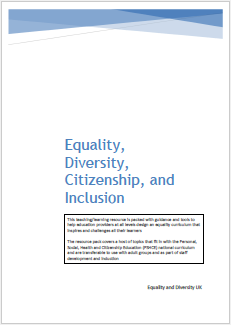
Packed with guidance and tools to help education providers design an equality curriculum that inspires and challenges learners. It covers topics that fit in with the PSHE national curriculum Can be used with adult groups in staff development and induction.
The Facilitator's Handbook - an Equality and Diversity Training self-study pack - has been specifically developed for use with teams. Updated to include the 2010 Equality Act, it includes examples of designing your own Equality and Inclusion Workshops and Training, as well as example session plans.
This pack provides advice and guidance for legal services firms on their duties and responsibilities to good equality and diversity practice. It is aimed at solicitors, barristers and other legal services companies that deal with the public and who are bound by the SRA Code of Conduct 2011.
An induction and refresher package for staff and volunteers working for public, private and 3rd Sector organisations involved in the provision of opportunities for people of all ages, backgrounds and abilities to participate in and enjoy sporting activities.
This equalities toolkit has been developed to provide some of the practical tools managers need to embed equality and diversity into the development, design and delivery of local authority services and into the recruitment and employment of staff.
Provides employers and employees with information and insights about racism in society, how it develops, and its impact on the organisation, staff, service users and clients. Contains practical approaches to creating a fair and inclusive environment for all.
The pack has been developed as a practical toolkit to help staff meet their legal and professional obligations and follow a twin-track approach to equality and diversity: that of tackling inequalities and fostering good relations between different groups.
This toolkit looks at the impact of racism on diverse applicants during the many stages of the recruitment process. Implementing diversity and inclusion practices during the recruitment and selection process is one of the first steps to developing a more diverse workplace, if this is a current struggle.
Don't Miss out!
Subscribe to receive the latest equality and diversity news, offers and updates