LGBTQIA+ Awareness and Inclusivity Training
Interactive LGBTQIA+ inclusion training for organisations, building understanding, respectful communication and practical action across diverse identities.
 >
>
Interactive LGBTQIA+ inclusion training for organisations, building understanding, respectful communication and practical action across diverse identities.
>
LGBTQIA+ people are not one homogeneous group. Experiences can differ according to sexual orientation, sex, gender reassignment, gender identity, race, disability, age, faith and other aspects of a person’s life. This course gives participants an accessible introduction to that diversity while focusing on respectful behaviour and practical organisational action.
A team member repeatedly uses the wrong pronouns for a colleague, insisting it is “too difficult to remember”. Delegates explore the impact of misgendering, how to intervene constructively & how to model inclusive language.
During social conversations, LGBTQIA+ staff feel unable to share aspects of their lives due to jokes or assumptions. Learners examine subtle exclusion, microaggressions & ways to create safer, more respectful team environments.
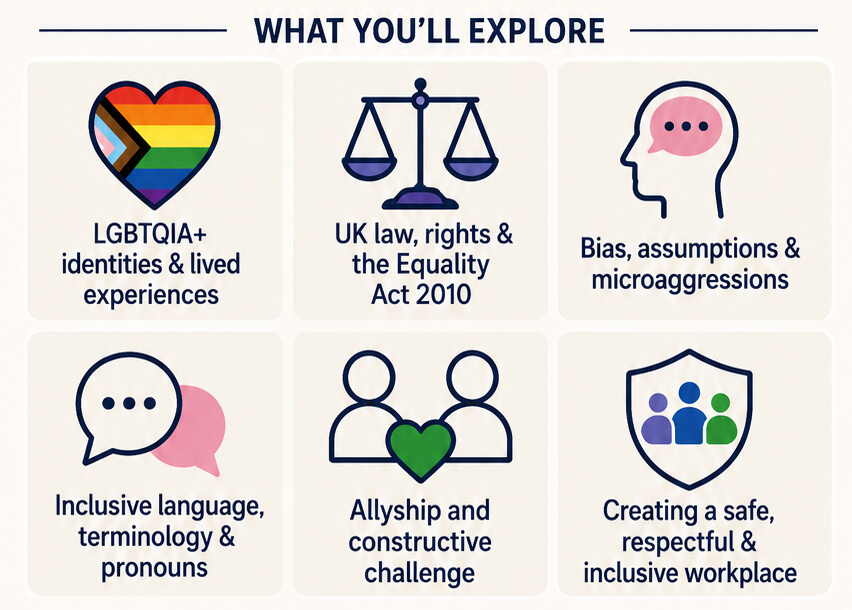
Through discussion, scenarios and reflective activities, delegates explore terminology, assumptions, barriers and the effects of exclusion. They consider how everyday communication, workplace culture, policies and services can support dignity and belonging.
The session distinguishes between inclusive language and the specific terminology used in equality law. It does not suggest that every identity represented by the LGBTQIA+ acronym is a separate protected characteristic under the Equality Act 2010.
This is the best option for organisations seeking a broad overview. For greater depth on sexual orientation, choose our LGB Inclusion and Sexual Orientation Awareness Training. For a specialist focus on trans inclusion, transition at work and gender reassignment protection, choose our Trans Inclusion and Gender Reassignment Awareness Training.
LGB Inclusion and Sexual Orientation Awareness
Best for focused learning about lesbian, gay and bisexual people, sexual orientation,
homophobia, biphobia and heterosexism.
LGBTQIA+ Inclusion
Best for a broad introduction across diverse sexual orientations, trans inclusion
and a wider range of LGBTQIA+ identities.
Trans Inclusion and Gender Reassignment Awareness
Best for greater depth on trans experiences, transition at work and the Equality Act
protected characteristic of gender reassignment.
Key concepts, terminology & the differences between sex, gender identity & sexual orientation.
Exploring discrimination, marginalisation, barriers & the impact these experiences can have.
An introduction to the Equality Act 2010, protected characteristics & forms of discrimination.
How stereotypes, culture & social messages shape assumptions & behaviours.
Building confidence with terminology, pronouns & constructive challenge.
Practical strategies for individuals, managers & organisations to embed LGBTQIA+ inclusion.
This course is suitable for staff at all levels, including managers, HR and people professionals, equality leads, customer-facing teams, educators, health and care staff, and organisations beginning or refreshing their LGBTQIA+ inclusion work.
Participants gain a shared foundation of knowledge, increased confidence in respectful communication and practical ideas for creating environments in which LGBTQIA+ people are treated fairly and with dignity.
All our courses are tailored to ensure the training reflects your organisation’s goals and priorities.
The course can be delivered face-to-face or online via Zoom or Teams.
Please note: the half-day rate is not always available for face-to-face sessions.
Over 25 years' experience delivering equality, diversity and inclusion training, consultancy and professional development.
Keep updated with the latest equality and diversity news, offers and updates.